What is Good Sense?
Good Sense is explicit, repeatable, and testable against reality. It is grounded in actual use, not just intention.
We believe that plans are not reality, feedback matters, and iteration is normal.
We offer an external, honest point of view. We are not here to moralize or judge, but to observe with humility.
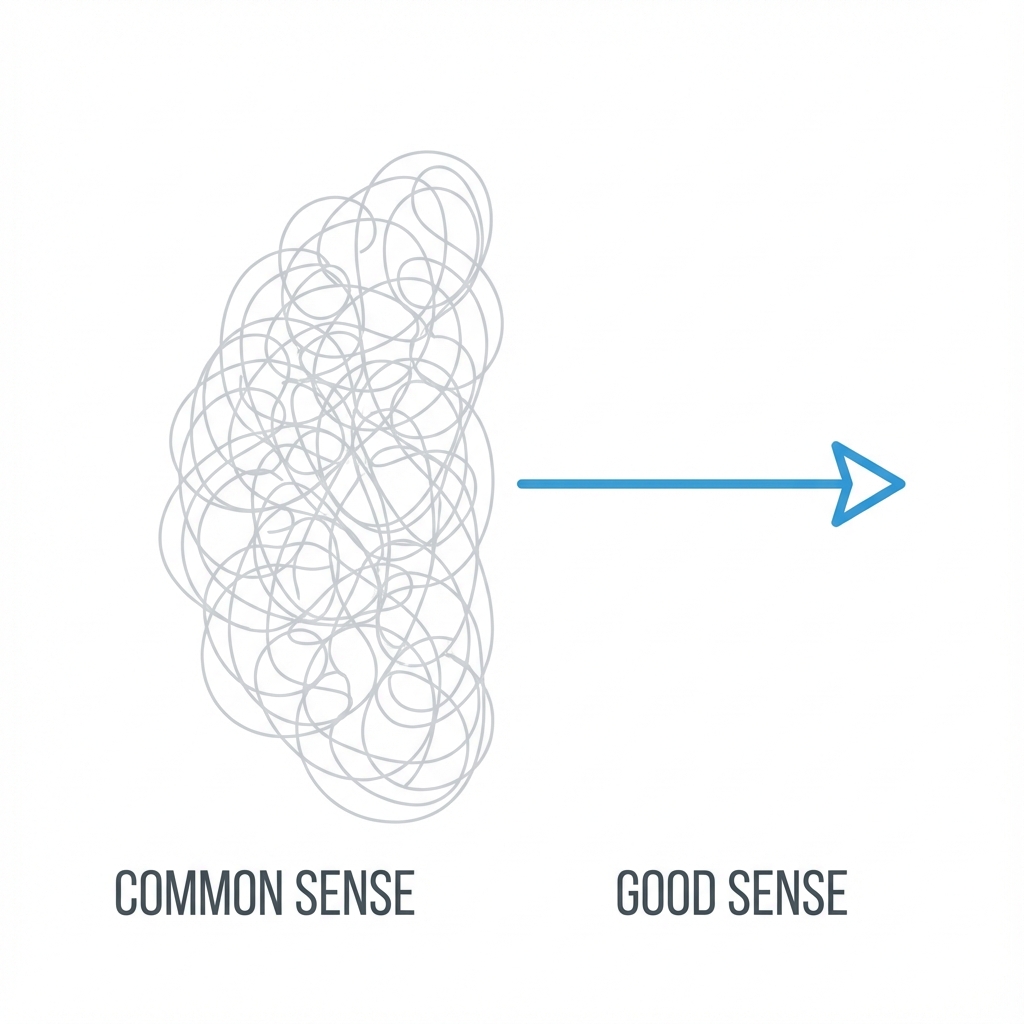
Good Sense vs. Common Sense
In English, both terms are often translated as “common sense,” but they point to different concepts.
Good Sense (Bon Sens)
- Core Idea: Practical and reasonable judgment applied to a concrete situation.
- Nature: An individual quality (reasoning well without overcomplicating).
- Example: “Putting on a coat when you are cold” (reacting to reality) or “Reading the contract before investing.”
- In short: Reasoning well in the concrete.
Common Sense (Sens Commun)
- Core Idea: The set of obvious things shared by a group or era (what “everyone” holds to be true).
- Nature: A collective social norm or dominant opinion.
- Example: “Putting on a coat because it is winter” (following the norm) or “Common sense says X is true.”
- In short: What most people believe is obvious (which isn’t always right).
The Test: if you can replace it with “practical judgment,” it’s Good Sense. If it’s “dominant opinion,” it’s Common Sense.
In our consulting, we rely on Good Sense. We look for the small, overlooked details that matter. We prioritize:
- Simpler over complex.
- No surprise over “wow factor”.
- No frustration over innovation theater.